Disclosure: If you buy through links on this page we may earn an affiliate commission, at no extra cost to you. It never changes our rating or what we recommend. As an Amazon Associate we earn from qualifying purchases. Read the full disclosure.
Lifepro Red Light Therapy Belt Review: The Numbers Do Not Add Up
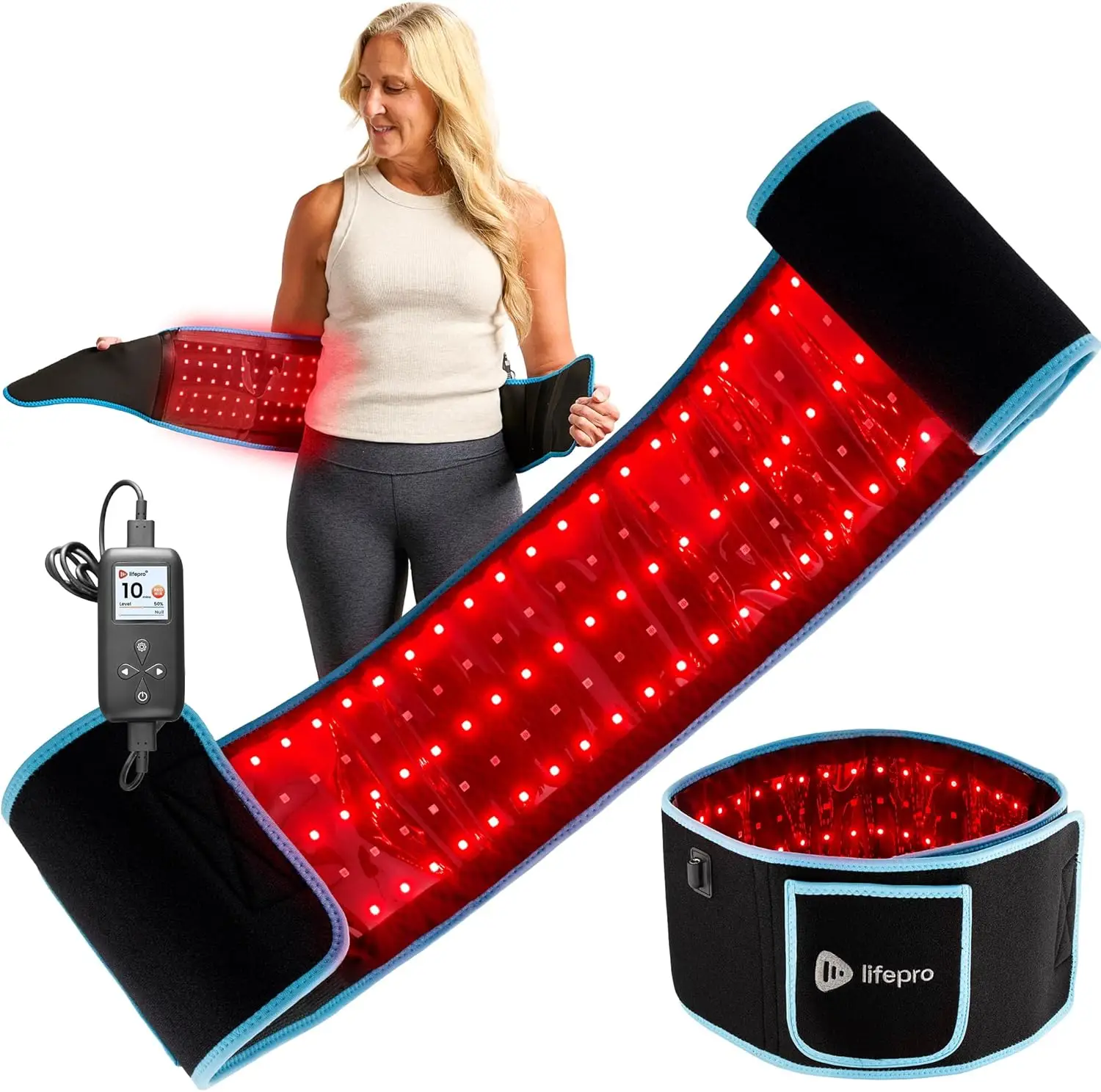
Lifepro advertises 73 mW/cm2 of irradiance. Its own user manual lists a power draw that cannot physically produce it. Adequate at the skin, underpowered at depth.
Lifepro publishes two irradiance figures for one product line that differ by about 7.5 times: 73 mW/cm² on the Lite and standard belts, and 96.8 W/m² (that is 9.68 mW/cm²) on the Pro. Irradiance is the number that decides whether a light therapy device does anything, and the belt's own USB power supply supports the lower figure. Not dangerous, and not useless. Oversold.
Specs
Wavelengths: 660nm red and 850nm near-infrared
Claimed irradiance: 73 mW/cm2 (Lite and standard)
Claimed on the Pro model: 96.8 W/m2, which is 9.68 mW/cm2
Power draw (own manual): 0.9 to 12.3 W from a 5V USB supply
LEDs: 105
Timer: 5 to 30 minutes with auto shut-off
Power: Corded; no internal battery
Independent testing: None. No lab has measured this belt
Pros
Comfortable wrap that covers a large area easily
Safety profile is genuinely benign for a waist-worn device
Twenty minutes of warmth and enforced rest has its own value
Lifetime warranty and a low price for the category
Cons
Two irradiance figures 7.5x apart across one product line
A 5V USB supply cannot produce the headline 73 mW/cm2
Red and near-infrared penetrate millimetres, not centimetres
Cochrane found light therapy relief for back pain clinically unimportant
No independent laboratory has ever measured this belt
Must stay plugged in throughout the session
Red light therapy is not pseudoscience. There is a real biological mechanism, a coherent dose-response literature, and a genuinely reassuring safety record. That is the honest starting point.
The problem with this belt is arithmetic. Lifepro advertises 73 mW/cm² of irradiance. Their own user manual lists the device drawing 8.5 to 12.3 watts of electrical power. Those two numbers cannot both be true, and you do not need a laboratory to see why.
The verdict
Reasonable if you want something low-risk and pleasant for surface-level aching, you understand you are buying a maybe, and $100 to $200 is money you are comfortable spending on a maybe. The safety profile is genuinely good.
Skip it if you are buying it to treat deep back muscle or disc pain. The light almost certainly is not reaching that tissue in a meaningful dose, and we will show the numbers below.
What the research actually found
Two things are worth separating: whether photobiomodulation works at all, and whether this class of device delivers it.
Muscle soreness: the best signal, applied at the wrong time
A 2025 review pooling 19 trials across 672 people found light therapy reduced muscle soreness and improved next-day performance. Certainty was rated low, but the direction was consistent.
Here is the part nobody selling these mentions: the benefit showed up when light was applied before exercise, not after. These belts are sold almost universally for post-workout recovery. The protocol with the strongest evidence behind it is the one nobody markets.
Back pain: the reviews openly contradict each other
This is the belt’s headline use, and the literature does not agree with itself.
A 2015 meta-analysis of 7 trials found a pain reduction of 13.6mm on a 100mm scale, with no heterogeneity between studies. But the threshold usually treated as clinically meaningful for back pain is 15 to 20mm, so even this positive result falls short of mattering to a patient. It also produced no improvement in disability: people reported slightly less pain and were not able to do more.
A 2020 review in the Journal of Physiotherapy concluded flatly that photobiomodulation does not reduce pain or disability in non-specific low back pain compared with sham.
The Cochrane review found effects that were “statistically significant but clinically unimportant” and could not determine an optimal dose.
One more caveat that applies across the whole field: the great majority of positive trials used lasers or high-power cluster probes held in contact at specific points, not low-power LEDs spread across a wrap. Researchers argue LEDs should work by the same mechanism, and that argument is reasonable. It has not been demonstrated for wearable belts.
Why dose is the entire question
Light therapy has a biphasic dose response, which is an unusual and important property. Too little does nothing. Too much also does nothing, or makes things worse. Roughly 0.18 to 5 J/cm² tends to stimulate; 8.7 to 50 J/cm² frequently inhibits.
And joules are not interchangeable. In one striking experiment, 670nm light at 4 mW/cm² held for 1,250 seconds produced a clear effect. The identical total dose delivered faster, at 15 mW/cm², produced nothing. Same joules, different result. This is why “more power” is not automatically better and why the specification that matters is irradiance, not LED count.
The depth problem
The two wavelengths in this belt do very different jobs. 660nm red penetrates on the order of 1 to 3mm, which makes it essentially a skin wavelength. 850nm near-infrared goes deeper and is the only one with a plausible claim on muscle.
Even so, measurements through real tissue found roughly 30 to 40% of near-infrared light remaining at 5mm, about 10% at 10mm, and barely anything at 15 to 20mm. That was with high-powered pulsed lasers. Measurements specific to LEDs are far worse: around 0.6% at 6mm.
Your erector spinae muscles sit under 10 to 30mm of skin and fat.
The 73 mW/cm² claim, checked against Lifepro’s own manual
This is the part we think matters most, and you can verify every input yourself.
Lifepro’s own user manuals list the power the belt draws: 0.9W, 4.9W and 8.5W across its three intensity levels on the standard model, and a maximum of 12.3W on the Pro. That is consistent with a 5V USB power bank, which caps out around 12.5W.
LEDs at these wavelengths convert roughly 25 to 45% of electrical power into light. So 12.3W of electricity yields at most somewhere around 3 to 5.5W of actual light.
Now spread that across the belt. A 105-LED array on a wrap this size covers somewhere around 420 to 650 cm².
Figure
Source
Electrical draw, maximum
8.5W standard / 12.3W Pro
Lifepro user manuals
Optical output, generous estimate
~3 to 5.5W
Standard LED efficiency
Array area, estimated
~420 to 650 cm²
105 LEDs across the belt
Irradiance this implies
~4.6 to 13 mW/cm²
Optical power divided by area
Lifepro’s advertised figure
73 mW/cm²
Lifepro product page
Lifepro’s own Pro model figure
9.68 mW/cm²
Lifepro product page
Read the last two rows again. Lifepro publishes 73 mW/cm² for two models and 9.68 mW/cm² for a third, all with 105 LEDs and the same wavelengths. The 9.68 figure sits almost exactly where the physics says it should. The 73 figure is about 7.5 times higher than the device’s own power budget allows.
The likeliest explanation is mundane rather than sinister: 73 mW/cm² is probably a reading taken with the sensor pressed directly against a single LED, rather than averaged across the array. That is a common way to measure, and it produces a number that is true of one square centimetre and false of the belt.
To be clear about what this is: we have not measured this belt. Nobody has, publicly. This is arithmetic performed on Lifepro’s own published wattage and standard LED efficiency figures. We would happily revise it if an instrumented measurement appeared.
What that means for a session
Working from the realistic figure of roughly 9.7 mW/cm²:
Session length
Dose at the skin
At 10mm deep (optimistic)
10 minutes
5.8 J/cm²
0.58 J/cm²
20 minutes
11.6 J/cm²
1.16 J/cm²
30 minutes
17.5 J/cm²
1.75 J/cm²
So the honest conclusion is split, and it is more interesting than a simple thumbs down.
At the skin, this belt is adequately dosed. A 20 to 30 minute session delivers 12 to 17 J/cm² to the surface, which is genuinely within the range used in trials. If light on skin does something useful, this belt does it.
At depth, it is not. Even using the generous laser-derived figure, under 2 J/cm² reaches 10mm. Using LED-specific measurements it is a fraction of that. It is very unlikely to be delivering a therapeutic dose to back muscle, which is what it is sold to treat.
“FDA registered” does not mean what it sounds like
This phrase does a lot of work in red light marketing, so it is worth being precise.
FDA registered means a company filled in a form and paid a fee. No product review of any kind.
FDA cleared means the FDA reviewed a submission showing the device is comparable to an existing one.
FDA approved is a much higher bar that applies to high-risk devices. No red light belt is FDA approved.
There is a structural loophole here. A device sold as a therapeutic infrared lamp is exempt from FDA review entirely, while a device sold for pain therapy requires clearance. So a belt marketed for “warming,” “relaxation” or “circulation” can be sold with no efficacy review at all. Lifepro’s own product page for one model states plainly: “please keep in mind that this is not a medical device.”
Regulators do act in this category. In 2020 the FTC obtained a $22 million judgment against the marketers of a low-level laser device advertised as clinically proven for chronic pain. As the FTC put it, when sellers say their devices relieve pain, they had better have the proof.
Safety, which is the genuinely good news
Across 14 trials in a 2026 review of photobiomodulation for chronic pain, 13 reported zero adverse events. The exception reported only transient warmth and tingling that resolved on its own, and occurred in the sham group too. Cochrane likewise found no adverse effects. If you buy this and it does nothing, the realistic downside is the money.
That said, four real cautions:
Burns are the actual risk. Independent measurement of consumer LED devices found surface temperature rises of 5.7 to 7.8 °C after three minutes. A belt strapped tight, under clothing, for 30 minutes, with no air getting to the skin, is a low-temperature burn waiting to happen if you cannot feel it. Do not sleep in it.
Reduced sensation. Diabetic neuropathy or any nerve damage means you may not feel a burn developing. Ask a clinician first.
Pregnancy. There is no evidence of harm and no adequate safety data either. This belt is worn precisely over the lower back and abdomen. The sensible course is not to.
Over any known or suspected tumour. The proposed mechanism is increased cellular activity. Applying that over a growth is a theoretical risk nobody has excluded.
Also worth knowing: 850nm near-infrared is invisible, so it does not trigger your blink reflex. Do not look into the LEDs, and be aware your eyes will not warn you. For a belt worn at the waist this is mostly academic.
One documentation gap worth flagging: the manuals we could find carry electrical safety warnings but no medical contraindications list at all. No pregnancy warning, no cancer warning, no neuropathy warning. For a product sold for pain relief, that is thin.
The warranty is unclear. Lifepro advertises a “lifetime warranty.” Best Buy lists the same model number with “No Warranty” for parts and labour. Get the terms in writing before you rely on them.
The sale price is the price. All three models sit permanently at a discount from an MSRP nobody appears to pay. Treat $99 to $200 as the real cost, not a saving.
Who should buy something else
If you want to reach a deep muscle knot, light is the wrong instrument. Sustained mechanical pressure is what releases a trigger point. A trigger point cane costs $30 and reaches places this belt cannot.
If the problem is a specific spot you can point to, see our guide to identifying which muscle it is first. A belt treats an area; a knot needs a point.
If you want heat, buy a heat wrap. It costs a fraction as much and the evidence for superficial heat, while itself thin, is no worse.
If you have undiagnosed back pain, get it assessed before buying any device.
Frequently asked questions
Does red light therapy work?
For muscle soreness there is a modest, low-certainty signal, strongest when light is applied before exercise rather than after. For chronic back pain the reviews openly contradict each other, and the most favourable result was still below the threshold that would matter to a patient. It is a maybe, not a treatment.
Is a more expensive panel better than a belt?
Possibly, if it genuinely delivers higher irradiance, but you face the same verification problem. Almost no consumer device has been independently measured, and the one peer-reviewed study that measured five of them found two lost half their output within three minutes. Advertised irradiance in this category is close to unverifiable.
How long should a session be?
Lifepro suggests 5 to 30 minutes. Given the biphasic dose response, longer is not automatically better, and there is no reliable way to know where the optimum sits without knowing the true irradiance. Twenty minutes is a reasonable middle.
Will I feel anything?
Warmth, mostly. That is the heating element and the LEDs, not evidence of a therapeutic effect. Photobiomodulation is specifically supposed to be non-thermal.
How we assessed this
We have not tested this device and no independent outlet has published an instrumented measurement of it, or of any comparable belt. This review compares Lifepro’s published specifications against their own user manuals, works out what those figures physically permit, and sets the result against the doses used in the clinical literature. Our method is on the how we research page. If Lifepro publishes a measurement distance and method, or an independent lab measures this belt, we will update it.