Disclosure: If you buy through links on this page we may earn an affiliate commission, at no extra cost to you. It never changes our rating or what we recommend. As an Amazon Associate we earn from qualifying purchases. Read the full disclosure.
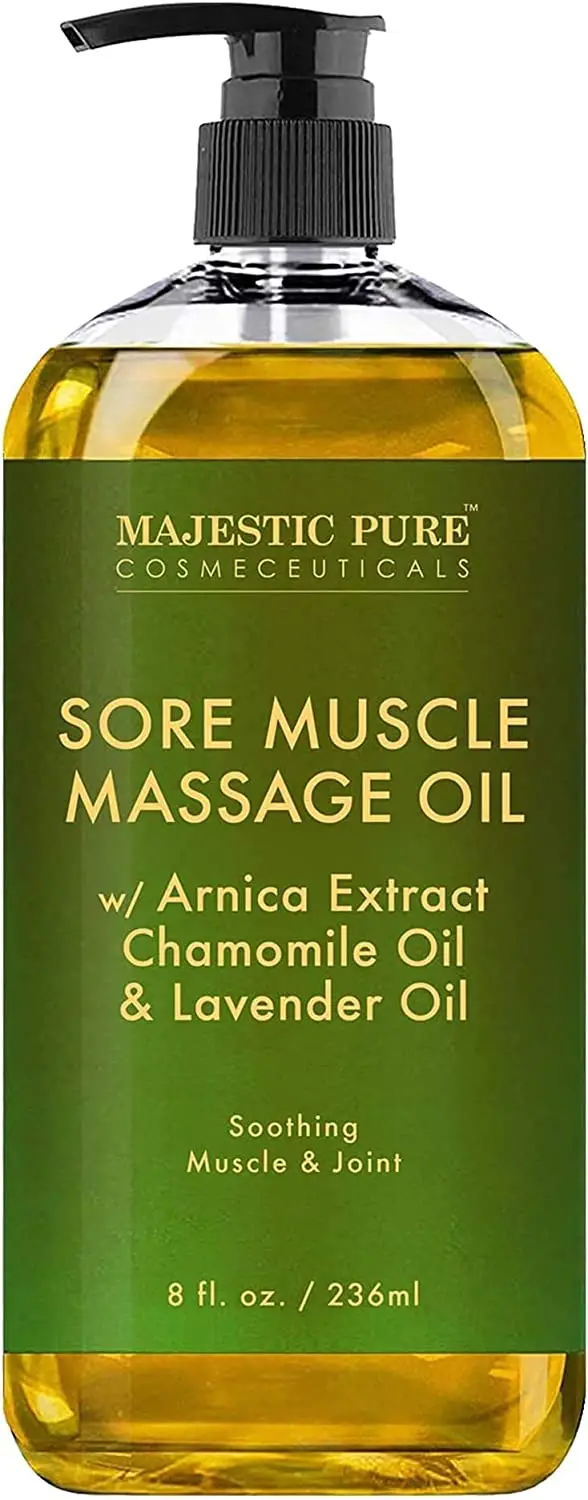
Majestic Pure Arnica Massage Oil Review: Glide, Scent and What Arnica Actually Does
An arnica-based massage oil. What it is genuinely good for as a glide medium, and what arnica itself is and is not shown to do.
A competent sweet almond massage oil sold on an arnica premise the evidence does not support. The best-designed trial of topical arnica for muscle soreness found the arnica-treated legs hurt more than placebo at 24 hours. The trials that did show benefit used preparations at 50% tincture by weight; this bottle discloses no concentration at all. Buy it as a well-made scented massage oil, which it is. Do not pay a premium for the arnica.
Arnica concentration: Not disclosed by the manufacturer
Concentration used in positive trials: 50 g tincture per 100 g
Other actives: Mint, lavender, plus patchouli and pine or grapefruit
Approx price: About $3 per fl oz
Pros
Almond base gives good slip and a long working time
Slower absorption means less reapplying mid-massage
Fairly priced for a scented almond oil
Massage itself has better evidence than arnica does
Cons
Best soreness trial found arnica worse than placebo at 24 hours
Arnica concentration is not disclosed anywhere
Described as unscented while containing four essential oils
Ingredient list differs between the maker and ingredient databases
Arnica and chamomile are both ragweed-family allergens
Almond base is unsuitable if you have a tree nut allergy
The best-designed trial of topical arnica for muscle soreness found that the arnica-treated legs hurt more than the placebo legs.
That is not a typo, and it is where any honest review of an arnica massage oil has to start.
The verdict
As a massage oil, this is a competent product. The base is sweet almond oil, which is the industry default for good reason: it has good slip, moderate absorption, and leaves enough film that you are not reapplying every two minutes. At roughly $3 per fluid ounce it is fairly priced for a scented almond oil.
As an arnica treatment, the evidence does not support it. Not because arnica is nonsense, but because the trials that showed anything used preparations at 50% tincture by weight, and this product does not disclose its arnica concentration at all.
Buy it if you want a pleasant oil to do self-massage with. Do not buy it expecting the arnica to be the active ingredient. On current evidence, the massage is the active ingredient.
What the research on topical arnica actually shows
First, a distinction that gets deliberately blurred in this market. There are two completely different things sold as arnica:
Herbal topical arnica — a real plant extract at a material concentration, containing compounds that genuinely do suppress inflammatory signalling in laboratory conditions. Plausible mechanism, contested clinical effect.
Homeopathic arnica — diluted to the point where, at 12C and beyond, not a single molecule of arnica remains. This is not a gentler version of the herb. It is a different product category.
Positive results from one are routinely used to sell the other. Any source that does not separate them is not worth reading.
On muscle soreness specifically, the evidence is negative
The most relevant trial randomised 53 people, double-blind and placebo-controlled, using a calf-raise protocol to induce soreness in both legs and treating one leg with topical arnica.
At 24 hours the arnica legs scored 3.04 for pain against 2.36 for placebo, a statistically significant difference in the wrong direction. There was no difference at day three or day four, and none in muscle tenderness or ankle range of motion.
We should not over-read a single trial of 53 people, and the most likely explanation is a mild irritant response to the preparation rather than anything mysterious. But it is the best-designed test of exactly this use, and it did not merely fail to find a benefit.
A 2021 analysis of the wider literature put it plainly: trials of arnica for exercise-related muscle soreness are negative.
The regulators have already reached a verdict
This is the most useful fact in the whole subject and almost nobody selling arnica mentions it.
The European Medicines Agency reviewed the clinical trial evidence for arnica flower and granted it traditional-use registration only, explicitly declining well-established-use status. Their assessment states that the clinical trials “have limitations and are not suitable to support a well-established use of Arnica.”
In plain terms: arnica is permitted to claim relief of bruises, sprains and local muscle pain on the basis of thirty years of traditional use, not on the basis of demonstrated efficacy. Health Canada takes the same line, permitting only “traditionally used in Herbal Medicine.”
Meanwhile, massage itself has better evidence than arnica
A meta-analysis of 11 trials covering 504 people found massage reduced delayed-onset muscle soreness at 24 hours, and substantially more at 48 hours and 72 hours, along with reduced creatine kinase. The authors are candid that the underlying trial quality was low and blinding is impossible with massage, so discount the size of the effect. But the direction is consistent and the effect sizes are considerably larger than anything attributed to arnica.
No trial has ever compared arnica oil massage against identical massage with a plain oil. Until one does, the honest reading is that you are buying a lubricant for an intervention that works, not an active ingredient.
The concentration problem
Here is the gap between the research and the bottle.
Study
Preparation
Arnica concentration
Knee osteoarthritis trial
Fresh plant tincture gel
50 g tincture per 100 g
Hand osteoarthritis trial
Tincture gel
50 g tincture per 100 g
Laser bruising trial
Topical
20%
Muscle soreness trial
Gel
~1% — weak, equivocal result
This product
Infused oil
Not disclosed
The trials with genuinely positive musculoskeletal results used a preparation that was half tincture by weight. That is pharmaceutical strength, not body oil strength.
There is even a defined range for an arnica oil specifically: Health Canada’s monograph permits 1 to 15% dried flower extract prepared in a vegetable oil. A product that does not state its percentage cannot be placed anywhere in that range.
Two further problems compound it. “Arnica Montana Extract” is a cosmetic ingredient name with no defined strength — a weak glycerine extract and a strong alcoholic tincture carry the same label. And the plant itself varies: the active compound content differs substantially depending on where it was grown. Even a stated percentage would not guarantee a stated dose.
On the ingredient list, arnica sits third, behind two almond oils. Under labelling rules that tells you it is present at more than the trailing essential oils, but ingredients below 1% may be listed in any order. It is entirely consistent with a concentration one or two orders of magnitude below what the trials used.
What it is actually good at
A massage oil’s job is mechanical, not pharmacological: reduce friction so you can work sustained strokes without dragging the skin. On that measure this is a sensible formulation.
The base is hydrogenated sweet almond oil plus sweet almond oil. Almond oil is high in oleic acid, which means good slip and slower absorption — and for massage slower absorption is a feature, not a fault. An oil that vanishes into the skin needs constant reapplication. The hydrogenated fraction thickens it and improves shelf stability.
If you want a lighter, faster-absorbing feel, grapeseed or fractionated coconut oil are drier. If you want maximum shelf life, jojoba is the most oxidation-resistant. But almond is the industry standard because it works.
Two things on the label that do not hold up
It is described as “unscented.” The formula contains mint, lavender and either patchouli and pine or grapefruit depending on the version. Scent is by some distance the most common complaint from buyers, one of whom likened it to engine cleaner. Whatever this oil is, it is not unscented.
The ingredient list is not consistent between sources. The manufacturer’s own page lists patchouli and pine; an independent ingredient database lists grapefruit instead. That is either a reformulation or two products sharing a name, and it matters: expressed grapefruit oil is phototoxic. Check your actual bottle, and if grapefruit is listed, keep treated skin out of the sun.
Safety, which is more substantial than you would expect
Never swallow it. The FDA classifies arnica as unsafe for internal use. Ingestion has caused vomiting, internal bleeding, irregular heartbeat, organ damage and death. Keep it away from children. If swallowed, call Poison Control on 1-800-222-1222.
Never on broken skin. This is an explicit contraindication, not a suggestion, and it matters because sore muscles often come with grazes and blisters.
Avoid entirely if you react to ragweed, chrysanthemum, marigold, feverfew or echinacea. Arnica and chamomile are both in the same plant family, so this product gives you two exposures. Arnica is among the more allergenic members of it.
Avoid in pregnancy and breastfeeding. Safety has not been established and arnica has historical use as an abortifacient.
Check with a doctor if you take anticoagulants. Arnica may inhibit platelet aggregation.
The base is a tree nut. Predominantly almond oil, which matters if you have a nut allergy.
An old bottle is more allergenic than a new one. The linalool in lavender oxidises on contact with air into compounds that are considerably more sensitising than the original. Around 10% of people investigated for suspected contact dermatitis test positive to these. Keep the cap on, store it dark, and do not nurse one bottle for three years.
On current evidence, no. The best-designed muscle soreness trial found arnica performed worse than placebo at 24 hours, and European regulators permit arnica claims on the basis of traditional use rather than demonstrated efficacy.
So is this product a waste of money?
Not if you want a massage oil. It is a well-made almond oil base at a fair price, and massage has better evidence than arnica does. It is a waste of money only if you are paying a premium specifically for the arnica.
Would a plain carrier oil do the same job?
Mechanically, yes. A bottle of plain sweet almond or fractionated coconut oil delivers the same glide, usually for less. What you gain here is the scent and the convenience of a blend already made up.
Can I use it on a knot in my back?
Yes, as a lubricant. It will not release the knot on its own. Sustained pressure does that, and our guide to releasing a knot you cannot reach covers how.
How we assessed this
We have not tested this product and make no claim to have. This review sets the published ingredient list against the clinical trial literature on topical arnica, the concentrations used in those trials, and the positions taken by the European Medicines Agency and Health Canada. Our method is on the how we research page.