

Yes — tight, tender spots in the upper trapezius and the small muscles at the base of the skull can produce genuine head pain, and the mechanism behind it is well understood. But two things are usually left out of articles on this topic, and both change what you should do about it.
The first is that a tender neck muscle does not rule out migraine — in fact most migraine sufferers have neck pain too. The second is that the evidence for treating headaches by working on muscle knots is positive in direction but weak in quality. It is worth trying. It is not a cure, and anyone telling you otherwise is overselling it.
How a neck muscle makes your head hurt
This part is genuinely well established. Nerves carrying sensation from the upper neck (the C1 to C3 nerve roots) and nerves carrying sensation from the face and head (the trigeminal nerve) both feed into the same relay station in the brainstem — the trigeminocervical nucleus.
Because those signals converge on shared neurons, the brain cannot always tell which one it is receiving. A pain signal originating in the trapezius can be interpreted as coming from the temple or behind the eye. That is not the muscle “radiating” pain anywhere. It is a wiring convergence, and it is why neck problems produce headaches at all.
An honest note about the word “knot”
We should say this plainly, because almost nobody in this space does.
The tender, ropy band you can feel in your trapezius is real. Your experience of it is not in question. But the standard explanation — that it is a discrete contracted lesion trapped in an “energy crisis” — is contested science, not settled fact.
- A systematic review of nine studies found clinicians cannot reliably agree on where trigger points are by feel. Agreement scores ranged from negative to good depending on the sign. The authors concluded physical examination “could not be recommended as a reliable test for the diagnosis of trigger points.”
- A 2015 paper in Rheumatology went further, arguing that trigger points and the vicious cycle said to maintain them “are inventions that have no scientific basis.” The same authors were careful to add that this “is not to deny the existence of the clinical phenomena themselves.”
- Even sympathetic reviews concede the referral maps “are not yet flawless” and that trigger points may be a symptom rather than a cause.
Why does this matter to someone with a headache? Because it sets expectations honestly. Pressing on a sore spot often produces real, immediate relief. Whether you have “released” a knot, or temporarily turned down a sensitised nerve pathway, nobody can currently say. The relief is worth having either way — but it explains why the effect frequently does not last, and why the fix is usually about changing the load on the muscle rather than hunting the lump.
Which muscle sends pain where
Four muscles account for most muscle-driven head pain, and each has a recognisable pattern. Matching your pain to the pattern tells you where to look.
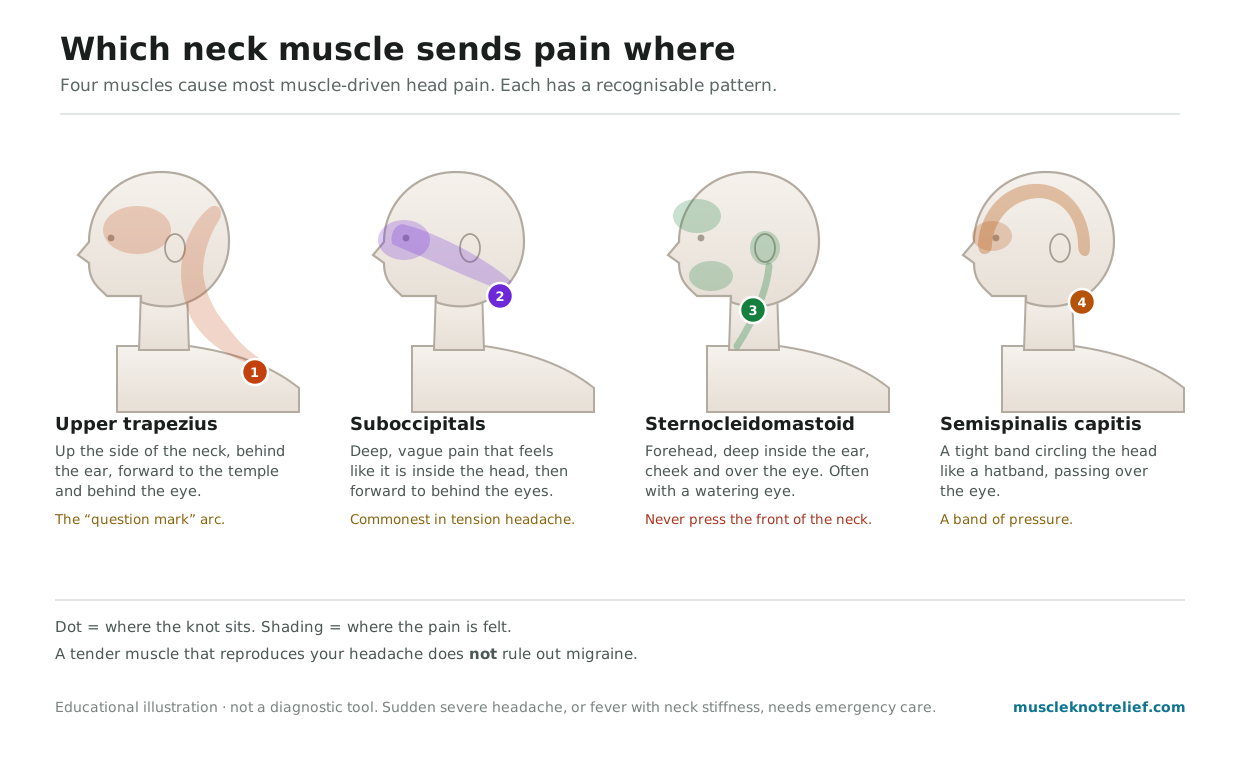
| Muscle | Where it sits | Where the head pain lands |
|---|---|---|
| Upper trapezius | The ridge you pinch between thumb and fingers where neck meets shoulder | Up the side of the neck, behind the ear, forward to the temple, often behind the eye. Sometimes the jaw. Almost always one side only. |
| Suboccipitals | Four small muscles right at the base of the skull | Deep, vague, inside the head pain running from the back of the head to the forehead and behind the eyes. Often both sides. |
| Sternocleidomastoid | The rope running from behind the ear down to the collarbone | Forehead, deep in the ear, cheek, over the eye, top of the head. Sometimes with watering eyes or a blocked-feeling nose. |
| Semispinalis capitis | Back of the neck, deeper than trapezius | A band circling the head like a tight hatband, over the eye. |
The trapezius pattern is often called the question mark — up the neck, curling around the ear, hooking forward into the temple. It is a useful mental picture, though it is teaching shorthand rather than a formal clinical sign.
The best controlled data here comes from a study of 50 children with chronic tension-type headache against 50 matched controls. Suboccipital tender points were the most common finding, in 80% of the headache group, and produced the largest referred pain areas of any muscle tested. Active trigger points were found only in the headache group, not the controls. If your headache feels like it is deep inside your skull rather than on the surface, the base of your skull is the place to look.
The home test — and its big limitation
The single most useful thing you can do at home is check for recognition. Press firmly on a tender spot in your upper trapezius and hold for 10 to 20 seconds. The question is not whether it hurts locally — it will. The question is whether it recreates your familiar headache.
If it does, a muscular component is present and is worth treating.
But here is what nearly every article on this subject gets wrong: a positive result does not rule out migraine.
- A 2022 meta-analysis of 24 studies covering 4,352 patients found neck pain in 73% of migraine sufferers, rising to 87% in chronic migraine, against 23% of people without headache. Migraine sufferers were roughly twelve times more likely than controls to have neck pain.
- In a study of people with one-sided migraine, all 20 patients had active trigger points, nearly always on the same side as the migraine — and pressing them reproduced the sensation they felt during attacks.
So a tender trapezius that reproduces your headache means a muscular component exists and may respond to treatment. It does not mean you have ruled anything out. The two coexist constantly, and neck treatment can help migraine sufferers without their diagnosis being muscular at all.
Muscle headache or migraine?
This is suggestive, not diagnostic. It should point you toward the right conversation with a doctor, not replace one.
| Points toward muscular | Points toward migraine | |
|---|---|---|
| Quality | Dull, steady, pressing. Not throbbing. | Throbbing, moderate to severe |
| Onset | Gradual, after sustained posture, a long drive, desk work, a heavy bag, or sleeping awkwardly | Recurrent stereotyped attacks with clear pain-free gaps |
| Direction | Starts at the neck or back of the head and travels forward | No consistent back-to-front pattern |
| Aura | None | Visual zigzags, blind spots, tingling or speech disturbance — essentially specific to migraine |
| Movement | Worse with neck movement and sustained neck positions | Worse with routine activity like walking or stairs |
| Other symptoms | Few. Little or no nausea. | Nausea or vomiting, both light and sound sensitivity |
| Behaviour | Usually keeps functioning | Wants to lie still in a dark, quiet room |
If you are getting frequent headaches, get a diagnosis. Migraine has genuinely effective treatments that muscle work will not substitute for, and a lot of people spend years massaging their shoulders for something that would respond far better to the right medication.
Does treating the muscle actually work?
Here is the honest summary, which is less exciting than most sites will tell you.
Systematic reviews of trigger point therapy for tension-type and cervicogenic headache find results that point in a favourable direction but are consistently graded as very low certainty. Dry needling performs no better than other treatments for pain relief. And the highest-quality trial in this field found benefit from manipulative therapy and specific neck exercise — not from trigger point release.
That last point is the useful one, and it repeats across the wider neck pain literature. A Cochrane review of exercise for neck disorders found strengthening the neck, shoulder and shoulder-blade muscles produced moderate-to-large pain reduction. Stretching alone showed no meaningful benefit.
Which inverts the usual advice. The morning stretch everyone recommends is the intervention with the least support; the boring, unglamorous thing — getting those muscles stronger over weeks — has the most.
Pressure work is still worth doing. It is cheap, safe, and often gives real immediate relief. Just treat it as symptom management rather than the fix.
How to treat it safely
Upper trapezius
This one is easy to reach. Pinch the ridge of muscle between your thumb and fingers, lift it slightly away from the neck, and squeeze at a discomfort level around 3 to 5 out of 10. Hold 20 to 60 seconds until the tenderness eases. Two or three spots, once a day.
A trigger point cane does the same job with leverage instead of grip strength, which matters if your hand tires before the muscle lets go — the usual reason people conclude this does not work.
Suboccipitals
Lie on your back and place two tennis balls in a sock, or your fingertips, right where the skull meets the neck. Let the weight of your head supply the pressure. Stay still and breathe for a minute or two. Gentle is the word here — grinding hard into that notch can irritate the greater occipital nerve and make things worse.
Then stretch, then strengthen
For the upper trapezius, tilt your ear toward your shoulder without rotating and let the opposite arm hang heavy. Hold 30 seconds. Then, over the following weeks, actually strengthen the area — that is the part with the evidence behind it.
What not to do
If your headaches are worst on waking, the overnight position may be the driver — see what actually causes a morning neck knot.This section is not boilerplate. Please read it.
- Never press into the front or sides of your neck. The carotid arteries, the carotid sinus, the jugular veins and the vagus nerve are all there. A published case report describes an 18-year-old woman who died of a massive stroke, attributed to a presumed carotid dissection, hours after a traditional neck massage. Vessel dissection following vigorous neck massage and manipulation is documented in multiple reports.
- Do not crack or wrench your own neck. Soft tissue pressure is reasonable self-care. Forceful joint manipulation is not, and upper cervical manipulation carries a small but real risk of vertebral artery injury.
- Stop immediately if pressure causes sharp or shooting pain, numbness or tingling down the arm, dizziness, visual change, nausea or ringing in the ears. New dizziness during neck work is a reason to get assessed, not something to push through.
- Get assessed rather than self-treating if you have had neck trauma, a connective tissue disorder such as Ehlers-Danlos or Marfan, rheumatoid arthritis or Down syndrome (both carry a risk of instability at the top of the neck), osteoporosis, a cancer history, or you take anticoagulants.
When a headache is an emergency
Call emergency services or go to an emergency department now if you have:
- A thunderclap headache — severe pain reaching maximum intensity in under a minute
- The worst headache of your life, or one unlike any you have had before
- Headache with fever, neck stiffness, rash, drowsiness or confusion. Do not wait for all of these — in adults with bacterial meningitis only about 44% had the classic triad, but 95% had at least two of fever, headache, neck stiffness and altered mental state
- Any neurological change: weakness, numbness, facial droop, slurred speech, double or lost vision, difficulty walking, seizure or confusion
- Headache after a head or neck injury, including days or weeks later, especially if you are older or take blood thinners
- Neck pain with a drooping eyelid and small pupil, or pulsatile ringing in one ear — possible artery dissection
See a doctor within a day or two if you have:
- A new headache and you are over 50, particularly with scalp tenderness, jaw ache when chewing, or visual disturbance. This can be giant cell arteritis, which causes permanent vision loss in around 8% of cases and needs treating urgently. Consumer articles routinely under-weight this one.
- Headache that is progressively worsening over days or weeks
- Headache that is worse in the morning, wakes you from sleep, or worsens when you cough, strain or bend
- Headache in pregnancy or after giving birth
- Headache on 15 or more days a month while regularly taking painkillers — the medication itself may be causing it
This article is general information, not medical advice. See our medical disclaimer.
Frequently asked questions
How do I know if my headache is from my neck?
The strongest home sign is recognition — sustained pressure on a tender neck muscle recreates your familiar head pain rather than just local soreness. Supporting signs are pain always on the same side, starting at the neck and moving forward, and worsening with neck positions. None of it is diagnostic, and it does not exclude migraine.
How long until it improves?
Pressure work often eases things within minutes, but that relief commonly fades. Lasting change usually takes weeks and comes from strengthening plus removing whatever loads the muscle daily — typically a low monitor, a one-shoulder bag, or long stretches without moving.
Can a massage gun help a tension headache?
On the upper trapezius, at low speed, yes — it is easy to reach over your own shoulder. Never use percussion on the front or sides of the neck, on the cervical spine itself, or at the base of the skull. Our massage gun review covers which specifications matter for upper-body muscle.
Is heat or ice better?
Heat, but with a caveat worth knowing: the evidence for heat on neck pain rests on just two small trials rated low certainty. Ice for neck pain has barely been studied at all. Heat is the better-supported option mostly because it is pleasant, cheap and safe, not because it is proven.
Where did this information come from?
Published clinical literature, including Cochrane reviews, systematic reviews of trigger point therapy for headache, and the ICHD-3 headache classification. Where evidence is weak we have said so rather than rounding it up. Our approach is on the how we research page.