Disclosure: If you buy through links on this page we may earn an affiliate commission, at no extra cost to you. It never changes our rating or what we recommend. As an Amazon Associate we earn from qualifying purchases. Read the full disclosure.
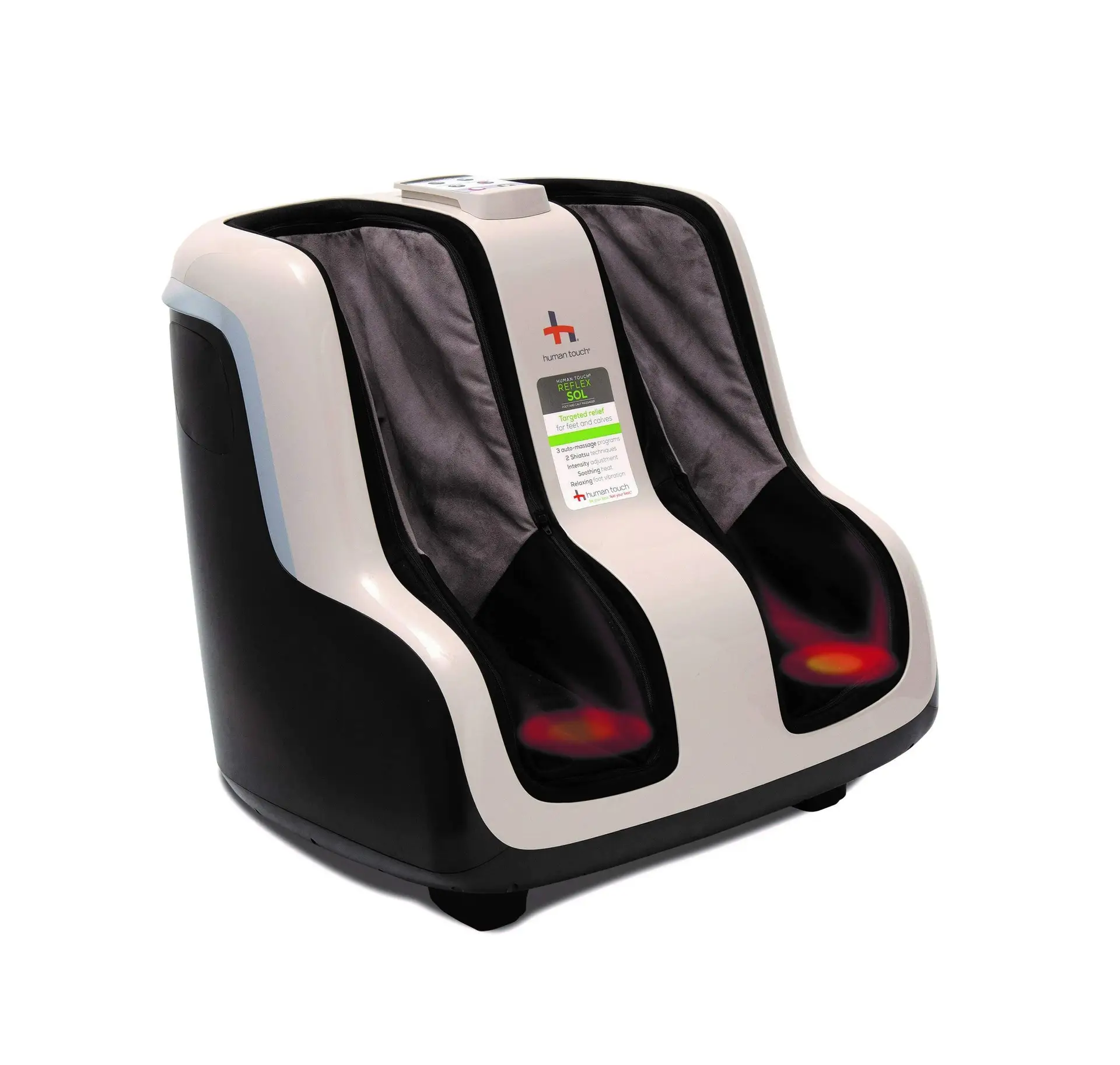
Human Touch Reflex SOL Foot and Calf Massager Review
A seated shiatsu unit for the feet and calves, aimed at plantar and calf tightness rather than upper-body knots.
A good foot massager with a calf-shaped recess, sold as a foot and calf device. Human Touch lists no air bladders in the calf well, so there is no real calf compression, and owners say the same. It is genuinely useful if bending down to use a ball is difficult, which is the strongest honest case for any machine here. It is the wrong tool for a calf knot, and powered massagers appear nowhere in the clinical guideline for plantar heel pain.
Specs
Foot action: Kneading rollers plus vibration
Calf action: Rolling recess. No air bladders, so no compression
Heat: Warm air, not a contact element
Auto shut-off: 15 minutes
Foot size: To men's 12; width is the real limit
Weight: 25 lbs
Warranty: 1 year (short for this price)
Independent testing: None exists for any Human Touch foot massager
Pros
Genuinely good, passive relief for tired feet
No bending required, which matters with back, hip or hand problems
Removable, machine-washable liners
Warm air is a lower burn risk than a contact heating element
Cons
No calf air bladders despite Compression appearing in retail titles
Rolling pressure cannot hold on a trigger point the way a ball can
Marketed for neuropathy, where heated foot devices are advised against
One-year warranty on a $300 to $419 machine
Retailers often publish the wrong model spec sheet
Heavy at 25 lbs and awkward to move
This is sold as a foot and calf massager. In practice it is a very good foot massager with a calf-shaped recess, and that distinction decides whether it is worth $300 to you.
The verdict
Buy it if you want passive, hands-free relief for tired, aching feet, and especially if bending down to use a ball is difficult. That last point is the strongest argument for any machine in this category and it is a real one.
Skip it if you are buying it for your calves. Human Touch’s own specification lists no air bladders in the calf well: the calf action is a rolling and vibrating recess, not compression. Owners are consistent about this, one noting it “barely compresses them.” Several retail listings put the word “Compression” in the title anyway.
What it is and what it costs
Mechanism
Under-foot kneading rollers plus vibration; calf well with rolling motion
Heat
Warm air blown into the chambers, not a contact element
Programs
3 auto programs, 2 intensity levels, 2 tilt angles, vibration on or off
Auto shut-off
15 minutes
Size and weight
19 x 18 x 18 in, 25 lb
Foot size
Listed to men’s 12; owners at 13 report it fits. Width is the real constraint
Cleaning
Removable, machine-washable liners
Warranty
1 year limited
Price
Around $299 to $419 depending on retailer
Two practical warnings. Human Touch sells three near-identical units, the Reflex5s, the SOL and the SOL Plus, and retailers routinely publish the wrong spec sheet: several “SOL” pages list three vibration modes and two heat settings, which are Plus features. Check the model on the box. And the 1-year warranty is short for a $300 to $420 electromechanical device; competitors at this price commonly offer two to three years.
Also worth knowing: some retailers sell this as final sale, non-returnable. For a 32 lb boxed item you cannot easily test first, check the return policy before the price.
Nobody has independently tested it
We checked the outlets that genuinely run hands-on foot massager testing. None of them has ever tested any Human Touch foot massager. Consumer Reports covers massage guns but not foot massagers. Everything else ranking for reviews of this product is affiliate content paraphrasing the marketing copy, and some of it is demonstrably wrong: one widely-cited review claims a two-year warranty extendable to five, which contradicts the manufacturer.
The usable signal is owner reviews, which run around 4.3 out of 5 across roughly a hundred at a major retailer, with the recurring complaints being weak calf coverage, bulk, and width for wider feet.
Why the calf distinction matters for muscle knots
If you are here because of calf knots, this is the important section.
Calf trigger points are worth understanding because of where they send pain. The soleus, which sits underneath the calf muscle you can see, has a trigger point low down near the Achilles that refers pain into the heel. It mimics plantar fasciitis closely enough that competent clinicians palpate the calf when assessing heel pain. The gastrocnemius has one on the inner side that refers into the arch of the foot, and it is the classic night cramp spot.
So the calf genuinely is where a lot of foot pain originates. The problem is that compression and trigger point pressure are different interventions:
Trigger point work is a small contact area, high local pressure, held on one identified spot for 30 to 90 seconds, with you adjusting to a specific level of discomfort.
Airbag compression is a large contact area, low pressure, cycling on and off, applied all the way round. Its plausible mechanism is shifting fluid and helping venous return, not releasing a taut band.
A device that claims both is claiming credit for two mechanisms while delivering one. And the SOL does not even deliver that one: with no bladders, it is not a compression device at all.
For an actual calf knot, a lacrosse ball under the calf while seated, or a foam roller, gives you the sustained localised pressure the research actually studied, for under $10. Our guide to trigger point tools covers the options.
One honest caveat on all of this: the evidence for sustained pressure on trigger points is itself modest. A meta-analysis of 17 trials found it raised the pressure threshold at which a spot hurts, but only against doing nothing, with no advantage over other active treatments, and no significant effect on actual reported pain.
If you bought it for plantar fasciitis
Powered massagers appear nowhere in the current clinical guideline for plantar heel pain. Not as a recommendation, not as an option.
What does carry the strongest grade of recommendation:
Plantar fascia and calf stretching, short and long term
Manual therapy to the joints and soft tissue, meaning skilled hands-on work
Taping, rigid or elastic, alongside other treatment
Night splints over one to three months, if your worst pain is the first step in the morning
Foot orthoses get a moderate grade and specifically should not be used alone. Dry needling to calf and plantar trigger points also gets a moderate grade, which is a clinician procedure, not something a machine substitutes for.
One trial worth knowing: 48 patients randomised to daily stretching or to high-load strength training, heel raises with a towel bunched under the toes, every second day. The strength group was substantially better at three months. By six and twelve months there was no difference. Loading gets you there faster; it does not change where you end up. Plantar fasciitis is largely self-limiting, and roughly nine in ten cases resolve without surgery.
The most generous defensible reading is that a massager is a comfort measure that may ease symptoms in the moment. It is not treatment.
And the cheapest option does something no machine can: a frozen water bottle rolled under the arch delivers pressure and cold at the same time. No powered massager offers cold, and cold is the better-supported half of that combination.
Safety, and one thing the marketing gets badly wrong
This product is frequently marketed for neuropathy. Some retail listings put the word in the title.
Podiatric guidance for anyone with diabetic neuropathy is the opposite: “Never use heating pads, hot water bottles or electric blankets; you can easily burn your feet without noticing.” A heated foot massager is functionally a heating pad you put your feet inside for fifteen minutes.
This is not theoretical. The FDA recorded a recall of 71,512 foot massagers after complaints of burns, where the design allowed burns to occur regardless of the control setting. Other brands in this category have been recalled for fire, burn and shock hazards.
In fairness to this unit specifically, warm air is a lower-risk approach than a contact heating element, the 15-minute shut-off is a genuine safeguard, and we found no recall for Human Touch. But if you have reduced sensation in your feet, talk to your podiatrist first, use it without heat, and check your feet afterwards.
Do not use a leg massager if you have:
A suspected blood clot. New swelling, warmth, tenderness or redness in one calf needs urgent medical assessment, not massage.
Significant peripheral arterial disease, or any leg infection or open wound
Decompensated heart failure
Severe neuropathy with loss of sensation
Recent injury, fracture or surgery to the leg or foot
Speak to a clinician first if you are pregnant, take anticoagulants, or have fragile skin. See our medical disclaimer.
What else your money buys
Option
Cost
Where it wins
Frozen water bottle
Free
Arch pressure plus cold. Nothing else does cold.
Lacrosse ball
$8
The only cheap option that does real trigger point pressure, on foot and calf
Stretching and loading programme
Free
The only approach with top-grade guideline support
Night splint
$20-40
Top-grade recommendation for first-step morning pain
Compression socks
$15-30
Leg heaviness from standing all day, for a fraction of the price
Physiotherapy course
$300-600
Same money as this machine, with actual guideline backing
Reflex SOL
$299-419
Passive, both feet, hands-free, no bending required
The machine’s genuine advantages are adherence and access. The best treatment is the one you actually do, and if you will use this nightly in front of the television but will not sit on the floor with a ball, it wins on that alone. If bending is difficult because of hip, back or knee problems, or arthritic hands, that is the clearest legitimate case for buying one.
Our advice: spend $25 on a ball, a roller and a frozen bottle for two weeks first. If they help but you will not keep doing them, then the machine is buying you adherence, and you will know exactly what you are paying for.
Frequently asked questions
Does it actually massage the calves?
Not meaningfully. The manufacturer lists no air bladders in the calf well, and owners consistently report the calf action is minimal. If calves are your reason for buying, choose a unit with actual airbags.
Will it fit large feet?
Length is listed to men’s 12 and owners at 13 report it fits. Width is the more common problem, and wide-footed buyers report it being tight.
Is reflexology real?
A systematic review of 23 trials concluded the best clinical evidence does not convincingly show reflexology to be effective for any medical condition. A device pressing your arch is pressing your arch. That can feel good without any of the map being true.
Is it noisy?
Nobody publishes a decibel figure for this or any competitor, so we cannot tell you. Roller units in this class are generally audible over quiet television.
How we assessed this
We have not tested this device, and no independent testing outlet has either. This review compares the manufacturer’s published specification against retailer claims and owner reports, and sets the intended uses against the clinical guideline for plantar heel pain and the trigger point literature. Our method is on the how we research page.