Disclosure: If you buy through links on this page we may earn an affiliate commission, at no extra cost to you. It never changes our rating or what we recommend. As an Amazon Associate we earn from qualifying purchases. Read the full disclosure.
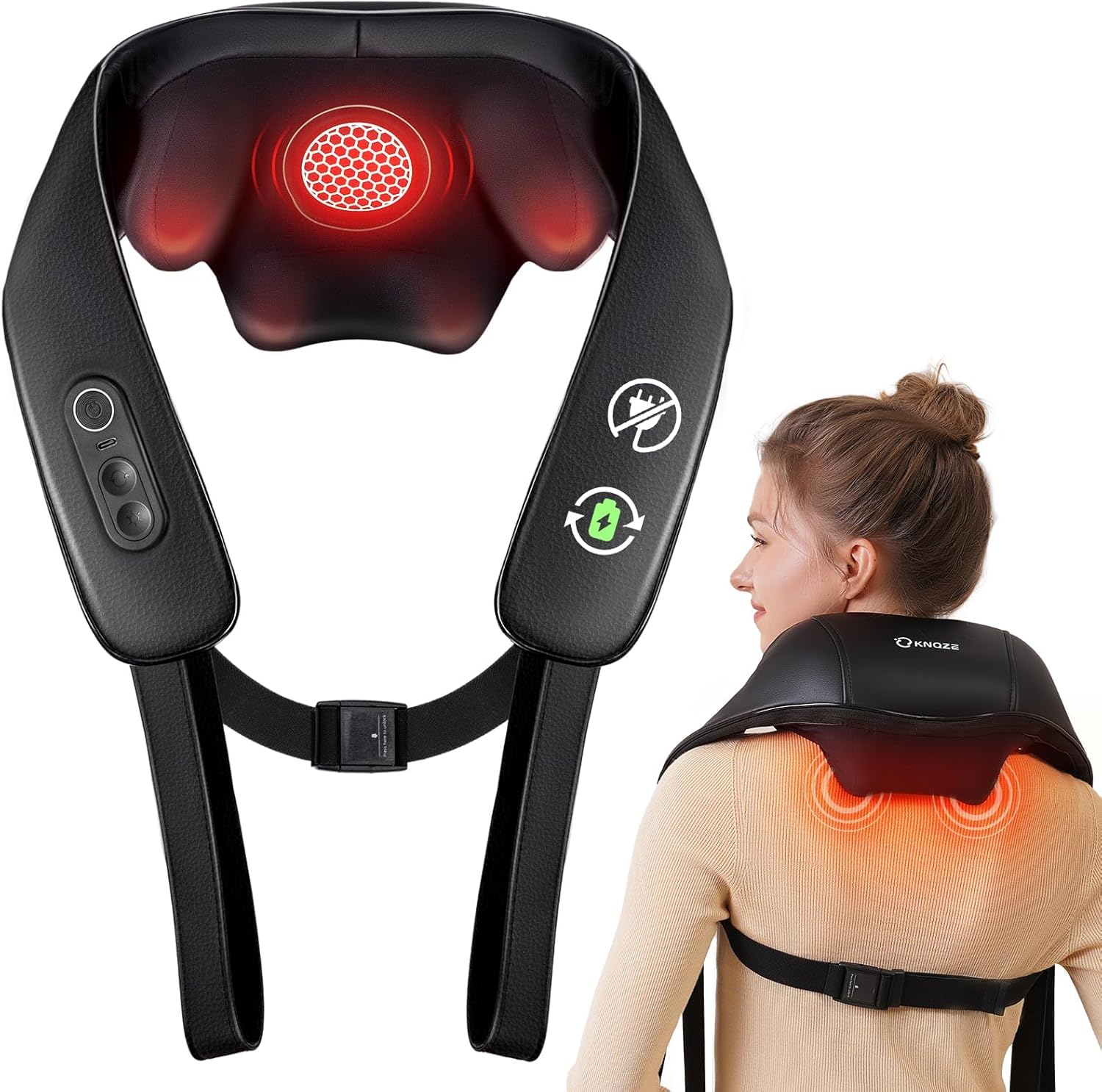
KNQZE Neck and Shoulder Massager Review: A Comfort Device, Not a Treatment
No independent outlet has tested it, the node count is unpublished, and the wrap largely misses the levator scapulae. A comfort device.
A comfort appliance sold as a therapy device. It delivers warmth and effortless rolling pressure across the upper trapezius, which is genuinely pleasant and genuinely useful if you want relief without doing anything. But no independent outlet has ever tested it, the node count and heat temperatures are unpublished, and the wrap geometry largely misses the levator scapulae — one of the muscles most often responsible for a stubborn neck knot. Buy it for passive comfort. For a specific knot, a $30 trigger point cane does more.
Specs
Battery: 2500 mAh, 60-90 min runtime, ~3.5 h charge
Heat temperature: Not published (sister model states 104-113F)
Motor: Not stated; likely brushed
Charging: USB-C
Warranty: 1 year
Pros
Completely passive - warmth and pressure while you sit and do nothing
Works well across the middle of the trapezius shelf
Good option if grip strength or shoulder mobility is limited
Cordless and USB-C, usable away from a socket
Cons
No independent testing of this product exists anywhere
Largely misses the levator scapulae, a common knot site
Node count and heat temperatures are not published
Rolling nodes cannot hold pressure on a chosen point
Heat is superficial; shuts off long before the studied dose
Sold across nine near-identical listings, so ratings are hard to trust
Shiatsu wraps like the KNQZE are the best-selling category of neck massager on Amazon, and they are consistently sold as deep-tissue therapy devices. They are not. They are comfort appliances — and understood that way, this one has a genuine job to do.
Here is the honest case for and against it, including the things the listing does not tell you.
The verdict
Buy it if you want warmth and passive, effortless relief across your upper back and the base of your neck while you sit and do nothing. That is a real benefit, especially for anyone who lacks the grip strength or shoulder mobility to work on themselves. Used daily, an effortless device beats a better tool you use twice.
Skip it if you have a specific knot you can point to. A wrap gives you rolling pressure wherever its geometry happens to land, which is the opposite of what releases a trigger point — sustained pressure on a spot you choose. For that, a $30 trigger point cane does the job better, and it reaches the muscle this device largely misses.
What we could not find out
We want to be upfront, because it shapes how much weight to put on anything written about this product — including this page.
No independent outlet has ever tested it. Not Consumer Reports, not Wirecutter, not any testing lab. Every review online, including the earlier version of this one, traces back to the manufacturer’s own copy. We have not tested it either, and we are not going to pretend we have.
These specifications are not published anywhere by anyone:
The node count. For a device whose entire function is rotating nodes, this is a strange omission. A different KNQZE model advertises six.
The actual heat temperatures. No figures are published for this model. A sister model states 104–113 °F. Figures of 108 °F and 119 °F circulate on affiliate sites with no source — including, previously, this one.
The auto-shutoff duration. Sister models use 10 or 15 minutes.
Whether the motor is brushed or brushless. KNQZE advertises “brushless motor” as an upgrade on a newer model, which strongly implies this one is brushed — the higher-wear option.
One more thing worth knowing: KNQZE runs at least nine near-identical listings for neck massagers. That is a standard Amazon private-label pattern, and it means star ratings are hard to attribute to any particular piece of hardware. The brand has no presence at any retailer that curates its catalogue. Treat the rating on the listing as weak evidence.
How these devices actually work
Pairs of rounded nodes sit on a rotating shaft and trace circles. Your tissue is compressed between the node and your own skeleton — which means the device supplies the motion and you supply the pressure, by pulling down on the straps or leaning back into a chair.
That is not shiatsu, incidentally. Shiatsu is sustained static thumb pressure. This is rolling compression that never dwells anywhere. The distinction drives almost every limitation below.
It also explains the most common complaint across this entire category, which is never about the motor. It is about fit: the wrap not sitting low enough, not staying put, needing to be held in place, or the U-shape not suiting a larger neck. Ratings for these devices tend to be bimodal — lots of fives and a hard cluster of ones — which is the signature of a product whose success depends entirely on your body shape.
The reach problem
This is the most important thing on this page, and no listing in the category will tell you.
Upper trapezius: yes. The middle of the trap shelf sits directly under the nodes. This is the muscle these devices are built for, and on that muscle they work.
Levator scapulae: largely no. And that matters, because the levator is one of the most common sites of neck knots — it is the muscle behind that specific complaint of not being able to turn your head to one side.
The anatomy explains why. The levator runs from the top four vertebrae of your neck down to the inner top corner of your shoulder blade, and it is buried under the sternocleidomastoid above and the trapezius below. Its upper portion is deep, high and to the side — there is no bone behind it to compress against except the vertebrae themselves, which is precisely where you do not want a machine pressing. Its lower attachment is reachable, but only if the wrap sits low enough on the shoulder, which is exactly what users report it does not do.
So the nodes work a fairly narrow band across the upper trapezius and the base of the neck. If your problem is the levator — see our guide to identifying which muscle your knot is in — this device is not aimed at it.
The heat, honestly
Heat feels good and there is nothing wrong with buying it for that. But the therapeutic framing does not survive contact with the evidence.
The protocol problem. The only systematic review of heat for neck pain found just two small trials, rated low certainty. Both used heat held at around 41 °C for four to six hours per application. These devices shut off automatically after 10 to 15 minutes. The intervention that produced the evidence is not the intervention this delivers — duration is what the research supports, and duration is the one thing a battery-powered wrap cannot give you.
The depth problem. Measured directly, 15 minutes of surface heat raises tissue temperature by about 3.8 °C at 1 cm deep, and 0.78 °C at 3 cm. That deeper figure is within normal body temperature variation — clinically meaningless. Surface heat is not reaching the muscle bellies the marketing describes. It is comfort and superficial blood flow, which is a real and pleasant thing, just not what is being sold.
The graphene claim. The one trial on graphene heating compared it against no treatment at all — there was no ordinary-heat comparison group. So it provides no evidence that graphene or “far infrared” outperforms a normal heating element at the same temperature. Graphene’s advantages here are engineering ones: thin, flexible, heats evenly and quickly. Those are worth something. They are not therapeutic.
Decoding the marketing
The claim
What it means
“4D” massage
Nothing. There is no mechanical definition. KNQZE’s own copy defines it as “simulates professional massage hands.” It is a number that goes up: rivals sell 6D and 8D.
“Far infrared 4–20 µm”
Every object at 40–50 °C emits far infrared in roughly that band. Including a hot water bottle.
“Deep tissue”
Physically limited by how much pressure a fabric strap can generate against a rolling node. Not deep.
“FSA/HSA eligible”
A tax classification, not a quality or efficacy signal.
“FDA registered”
Powered massagers are Class I devices exempt from premarket review. No regulator has assessed whether any of this works. Nothing in this category is “FDA approved.”
What the evidence says about massage devices generally
A 2024 Cochrane review covering 33 trials and nearly 2,000 people concluded that massage “may result in little or no difference” compared with placebo for neck pain — about 3.4 points on a 100-point scale, at low certainty.
But there is a genuinely useful detail buried in the subgroup analysis: higher-dose massage — at least eight sessions over four weeks, 30 minutes or more each — may reach clinical importance.
Which is an argument for a cheap device you use constantly over an expensive one you use occasionally. It is also the strongest argument for this product: the effortlessness is the point. Frequency beats hardware.
Who it is genuinely right for
You want to do nothing. Passive relief with warmth, while you sit. No other tool here offers that, and it is the honest reason to buy one.
Grip strength or shoulder mobility is limited. Arthritis, injury, or simply not being able to reach — a wrap needs neither.
Your tension is diffuse rather than pinpoint. A general tight band across both shoulders after a long day suits rolling compression well.
You will use it daily. Per the Cochrane dose finding, that consistency is what actually matters.
Who should buy something else
You can point to the exact spot. A discrete trigger point wants sustained pressure where you choose it. A trigger point cane does that for around $30, reaches the levator scapulae properly, never needs charging and cannot burn you.
Your knot is between your shoulder blades. A wrap does not reach there. A ball against a wall does, for under $10 — see our guide.
You want depth on large muscles. A percussion massager gives you user-controlled pressure a strap cannot.
You have neck pain you have not had assessed. Get a diagnosis before buying a device. Some causes of neck and shoulder pain need treating, not massaging.
Safety — please read this part
Keep it on the back and top of your shoulders. Never the front or sides of your neck. The carotid arteries run there.
This is not a theoretical caution. A published case describes a 79-year-old man who had an embolic stroke after using a handheld electric neck massager — the device ruptured an atherosclerotic plaque at the carotid artery. A separate case reports a vertebral artery dissection and cerebellar stroke from a percussion device.
These events are rare, and a strap-worn wrap sitting on the back of the shoulders is a lower-risk shape than a handheld device pressed wherever you like. But the risk concentrates in older adults with hardened arteries — which is precisely who these get bought for as gifts. Position matters more than people assume.
Speak to a doctor before using one if you are pregnant or recently gave birth; have a pacemaker or any implanted device; have a heart condition, diabetes, neuropathy or any reduced sensation; have a clotting disorder, phlebitis or thrombosis; have osteoporosis; have acute injury or inflammation; or are under active treatment. Not for children.
Do not fall asleep wearing it. Low-temperature contact burns can occur from around 44 °C given enough time, and reduced sensation raises that risk considerably. The auto-shutoff is your main protection.
Do not exceed about 30 minutes in one session, per manufacturer guidance across this category.
Never use it while driving.
Stop if you feel dizziness, tingling down an arm, visual change or nausea.
Worth knowing about the category as a whole: HoMedics recalled around 46,000 massagers in the US in January 2024 for overheating during charging, after 17 reports and one burn. A cheap imported shiatsu massager was recalled in the UK in 2022 for electric shock risk from inadequate internal insulation. No recall exists for KNQZE — but small marketplace brands are largely invisible to the recall system, so that is weak reassurance rather than a clean bill of health.
It will make the area feel looser and warmer, often noticeably. Whether it resolves a specific trigger point is doubtful — releasing one takes sustained pressure held on a chosen spot, and a rolling node does the opposite. Use it for general relief and something more precise for a specific knot.
Is the heat strong enough to matter?
For comfort, yes. Therapeutically, the heat reaches roughly 1 cm deep in any meaningful amount, and the trials showing benefit ran four to six hours per session against this device’s 10 to 15 minutes. Enjoy it as warmth rather than treatment.
Is it better than a cheap corded one?
Cordless buys freedom of movement and costs you torque headroom, plus adds a battery as a failure point. Corded units typically run around 24 W from the mains, more than a battery pack can sustain. If you will use it in one chair, corded is the more sensible buy.
Why not just book a massage?
A therapist will out-perform any device, and can reach and vary pressure in ways no strap can. The case for a device is frequency — the Cochrane data suggests eight or more sessions over four weeks is where benefit becomes meaningful, which is a lot of appointments.
How we assessed this
We have not tested this device and no independent outlet has either. This review compares the manufacturer’s published specifications and the gaps in them against the clinical evidence for heat and massage, the anatomy of the muscles involved, and recurring complaint patterns in long-term reviews across the category. Our method is on the how we research page.