

You went to bed fine. You woke up unable to turn your head, with a hot, tight band running from your neck into your shoulder. Somewhere in seven hours of lying still, something went wrong.
The usual explanation is that your muscles clenched all night, or that you “slept wrong.” The real picture is more interesting, and it changes what actually helps — including saving you from spending $80 on a pillow that the evidence says probably will not do much.
What actually happens overnight
The muscle-clenching story turns out not to hold up well. Researchers recorded trapezius muscle activity during sleep in 60 women, 33 with chronic neck and shoulder pain and 27 pain-free. The painful group did have more muscle activity overnight — but that activity was not associated with worse pain the following morning. The authors concluded it may not be causing the pain at all.
A better-supported explanation is not about muscle at all. It is about creep — what happens to collagen tissue held under sustained load.
Ligaments, joint capsules and discs deform predictably when loaded for long periods. Research on spinal tissue found that loads sustained for more than ten minutes can produce micro-damage in collagen tissue. You hold sleep positions for hours. If a joint at the side of your neck sits near the end of its range all night, the capsule slowly creeps, the tissue’s sense of position gets muddled, and the muscles around it respond by guarding. That guarding is what you feel in the morning.
The practical difference matters: if the problem is sustained end-range position rather than muscles seizing up, the fix is about position and movement, not about attacking the muscle.
One thing you can safely ignore: sleeping “in a draught” causing a stiff neck. We could find no research base for it whatsoever. It is folklore.
Position by position
The best study here filmed 53 people with infrared cameras over two nights — objective observation rather than asking people how they sleep, which they routinely get wrong. It classified positions as supportive or provocative.
People with neck symptoms spent a median of 185 minutes a night in provocative postures, against 84 minutes for those without — more than double.
An important caveat the researchers made themselves: this is a snapshot, so it cannot establish cause. People with sore necks may shift into awkward positions because they hurt, rather than the other way round. Only 13 people had neck symptoms. Treat this as a strong hint, not proof.
Stomach sleeping
Mechanically the hardest to defend. To breathe you must rotate your head to near its limit and hold it there for hours, usually with the neck slightly extended. That is exactly the sustained end-range loading described above, applied unevenly to the levator scapulae and upper trapezius on one side.
Being straight with you: no trial has shown that quitting stomach sleeping prevents morning neck pain. The reasoning is sound and consistent with the observational data, but every pillow company states it as established fact and it is not.
Side sleeping
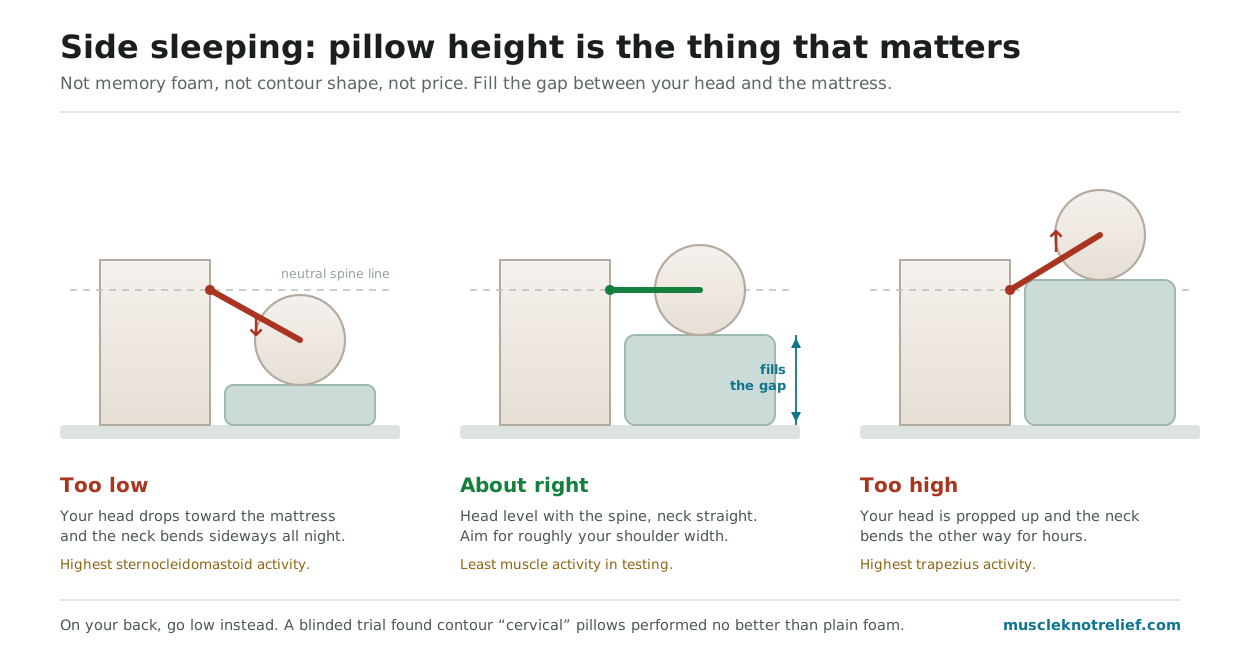
The most common position, and the one where pillow height genuinely matters — the pillow has to fill the gap between your head and the mattress, or your neck spends the night bent sideways.
A small study of 15 people tested pillow heights against shoulder width and found a pillow roughly equal to shoulder width produced the least muscle activity and the most comfort. Too low and the sternocleidomastoid works; too high and the trapezius does. Fifteen young, pain-free people is a pilot study, so hold it loosely — but it is a sensible rule of thumb.
The other side-sleeping fix is free: if your top leg falls forward across your body it twists your spine all night. A pillow between your knees stops that.
Back sleeping
Generally the kindest to the neck, provided the pillow is low. A thick pillow on your back props your chin toward your chest for hours.
One rarely-mentioned detail: a small study found that sleeping on your back with a hand resting on your forehead significantly raised trapezius and scalene activity compared with arms at your sides. Where your arms go matters too, not just your head.
What the pillow evidence actually says
This is where we are going to talk you out of a purchase.
Pillow research is mostly small, short, methodologically weak, and frequently funded by pillow companies. The most recent systematic review screened over 29,000 records and found only five interventional studies covering 239 people in total. Its conclusion: limited evidence supports specific pillows for chronic neck pain, with no particular type showing clear superiority.
An earlier review of nine studies did find statistically significant benefits — but the effect sizes were small (around 0.26 and 0.23), which is a long way from the transformation the marketing implies. The one large effect was user satisfaction, which is exactly the measure you would expect to inflate when people obviously know which pillow they were given.
The single most useful finding comes from a blinded trial by academic physiotherapy researchers, in which side-sleepers trialled five pillow types for a week each:
- Feather performed worst — the most waking symptoms and the highest dropout rate
- Latex performed best
- The foam contour pillow performed no better than an ordinary foam pillow
Read that last one again. The contoured “cervical” pillow — the shape sold hardest as orthopaedically engineered, usually at a premium — did not beat a plain foam pillow.
What you can act on: height matters more than material or marketing category. Aim to keep your head roughly in line with your spine — filling the head-to-mattress gap on your side, low on your back. If you are replacing one, latex has the least-bad evidence and feather the worst. Do not pay extra for a contour shape. And nobody has shown that any pillow prevents neck pain in someone who does not already have it.
What about the mattress?
Almost all mattress research is about lower back pain, not necks. The landmark trial, 313 people with chronic low back pain, found medium-firm mattresses outperformed firm ones. That is a real finding — about backs.
Whether mattress firmness affects neck pain has essentially not been studied. There is one indirect connection worth knowing: a mattress that lets your shoulder sink changes how high your pillow effectively sits, so the two interact. That is a mechanical inference, not a research finding.
A myth worth killing: side sleeping and shoulder pain
You will read everywhere that sleeping on your side causes shoulder pain. The largest study to look — 761 workers, examining sleep position against shoulder pain and rotator cuff problems — found no association between sleeping position and rotator cuff tendinopathy.
It went further in the opposite direction: people who slept with their arms overhead had lower odds of shoulder pain than back sleepers.
The researchers offered a fair caveat — people whose shoulders hurt may already have learned to avoid the position that provokes it, which could hide a real effect. Still: the claim is repeated as fact everywhere, and the study that looked hardest found the reverse.
When it is a wry neck, not a knot
There is a distinct condition that turns up on waking and gets mistaken for a bad knot: acute wry neck.
A knot is tenderness with some stiffness. Wry neck is a near-total loss of movement in one direction, with the head held in a position you cannot straighten without severe pain. It is a functional lock rather than soreness.
The reassuring part: most cases settle in two to three days, occasionally up to a week. Stay gently active within what you can tolerate, use simple painkillers and heat, and keep moving in the directions that do not hurt.
Do not wear a soft collar. It feels protective and it can prolong the problem. If it has not improved within about a week, get it looked at.
What to do this morning
- Move, gently. Slow, small range-of-motion in the directions that do not hurt. This counteracts the overnight stiffening and stops the protective guarding from settling in. Do not force anything.
- Heat, ten to fifteen minutes. Honest caveat: the evidence for heat on neck pain rests on two small trials rated low certainty. Ice has barely been studied at all. Heat wins mainly because it is cheap, pleasant and safe.
- Pressure on the sore spot, briefly. Pinch the trapezius between thumb and fingers, or use a ball against a wall for anything between the shoulder blades. Hold 20 to 60 seconds at a discomfort of 3 to 5 out of 10. Worth knowing: a Cochrane review of massage for neck pain found an average improvement of about 3.4 points on a 100-point scale — below what counts as clinically important, and no trials at all looked at acute pain like this. It feels good and it is safe. That is the honest pitch.
- Get on with your day. Resting a stiff neck tends to prolong it.
If the knot is between your shoulder blades rather than in your neck, see our guide to releasing a knot you cannot reach. If it is on top of your shoulder where nothing presses against a wall, a trigger point cane is the tool that reaches it.
Stopping it happening again
If the stiffness comes with head pain, see whether a trapezius knot is causing your headaches.Ordered by how well the evidence supports them, which is not the order you will see elsewhere.
- Strengthen your neck and shoulders. This is by some distance the best-evidenced intervention for neck pain — a Cochrane review found moderate-to-large benefit from strengthening, while stretching alone showed no meaningful benefit. It is the least exciting item on this list and the most effective.
- Match your pillow height to your position. The one genuinely interpretable finding in the pillow literature.
- Reduce time at end range. Move off your stomach if you can, and use a pillow between your knees so your top leg does not twist your spine.
- Fix your sleep generally. In the camera study, both symptomatic groups slept significantly worse across every measure used. Sleep quality and musculoskeletal pain feed each other, and this is probably a bigger lever than pillow shopping.
And once more, because it is the sentence the industry will not print: no trial has demonstrated that changing your sleeping position prevents morning neck pain. The study has not been done.
When morning neck pain is serious
Emergency — get help now:
- Neck stiffness with fever, severe headache, rash, light sensitivity, drowsiness or confusion. Do not wait for the full set: among adults with bacterial meningitis only about 44% had the classic triad, but 95% had at least two of fever, headache, neck stiffness and altered mental state. And a neck that still moves reasonably well does not rule it out.
- Chest pressure, or pain in the jaw, arm or back with sweating, nausea or breathlessness. The distinguishing feature is that cardiac pain does not change when you move or press your neck. Mechanical neck pain hurts more when you turn your head; referred heart pain does not care what your neck is doing. This presents atypically more often in women.
- Sudden severe neck pain at the front or side of the neck, with headache, a drooping eyelid, visual change or any neurological symptom — possible artery dissection. Average age is early forties, younger than most people expect.
See a doctor soon:
- Clumsiness with your hands plus unsteadiness walking — dropping things, struggling with buttons or keys, feeling unbalanced in the dark. This combination can indicate spinal cord compression in the neck, which is commonly missed because people report it as clumsiness and never connect it to their neck.
- Numbness, tingling or weakness travelling down an arm. Reassuringly, 80 to 90% of nerve-root cases settle without surgery in around four weeks — but progressive weakness needs review.
- Pain that wakes you at night or is unrelated to position and movement
- Fever, unexplained weight loss, or a history of cancer
- Neck pain following an accident or fall
- No improvement after about six weeks
This article is general information, not medical advice. See our medical disclaimer.
Frequently asked questions
How long should a morning neck knot last?
Ordinary stiffness usually eases within a day or two. A true wry neck, where you cannot turn your head at all, typically settles in two to three days and occasionally takes a week. Anything still there after a week deserves a look.
Is an expensive orthopaedic pillow worth it?
On current evidence, no. A blinded trial found contoured cervical pillows performed no better than plain foam ones, and the most recent systematic review found no pillow type clearly superior. Get the height right for how you sleep and save the money.
Should I stop sleeping on my stomach?
Probably worth trying if you keep waking with a stiff neck, because the position holds your head near its rotational limit for hours. But no study has proven that changing it helps, and sleep position is genuinely hard to change. A pillow that keeps you on your side is usually easier than willpower.
Should I crack my neck to release it?
No. Gentle movement and soft tissue pressure are reasonable self-care; forceful twisting is not. Upper-neck manipulation carries a small but documented risk of injuring an artery, and there are published cases of stroke following vigorous neck manipulation and massage.